"If you have to explain the gesture, the gesture hasn't done its job." Professor Synapse
On the morning of September 27, twelve new moves for Professor Synapse, our animated AI avatar, went up for review in one batch. Joseph Rosenbaum, our founder, had asked for all of them at once: rocking out with horns, tapping impatient fingers, pondering, push-ups, singing opera, dancing, holding up a clipboard, curling a dumbbell, listening to music, warming up over a burner, jumping onto a crate, and getting struck by lightning.
In that first review round, six were approved as they were. The other six each came back with a short note, and most of those notes said a version of the same thing: this doesn't read.
In animation, a move "reads" when a viewer gets it in one glance, without being told what it is. The six that didn't read are the useful part, because each failed in a way we can now name and avoid. Here are those six before and afters, the rules they added up to, and what any leader can take into a review of creative work.
If you're new to the series, post 1 covers why we built a character at all, and post 2 explains the library of reusable moves these twelve joined.
The principles of animation, and what "reads" means
Animators have a classic checklist for clear motion. The 12 principles of animation, set out by Disney animators Ollie Johnston and Frank Thomas in their 1981 book The Illusion of Life, include squash and stretch, anticipation, staging, arcs, timing and appeal.
We didn't start from that list. We started from renders and let the review tell us what was wrong. Even so, our fixes kept landing on ideas the classic principles already name, arcs and staging above all.
Our test for "reads" is simple. A move is judged the way most people will see it: at phone size, from the front, in one glance. Each review round produces a contact sheet, a grid of still frames from the key moments of each move, in the wide format and the vertical format used for shorts. The cells are small, around 420 pixels. If the idea isn't visible at that size, nothing else matters.
Before building, each move gets a one-line "silhouette": the single shape that must come across. For the rock-on gesture, that's the horns. For pondering, two fingers on the chin. For the clipboard, a hand clearly holding a board with words you can read.
Under the hood: the guide the AI agents follow when they build a move opens with that test. Every rule in it is there "because a version that was geometrically right still read wrong." A move can pass every automated check and still fail the only one that counts.
Before and after: six fixes from round 2
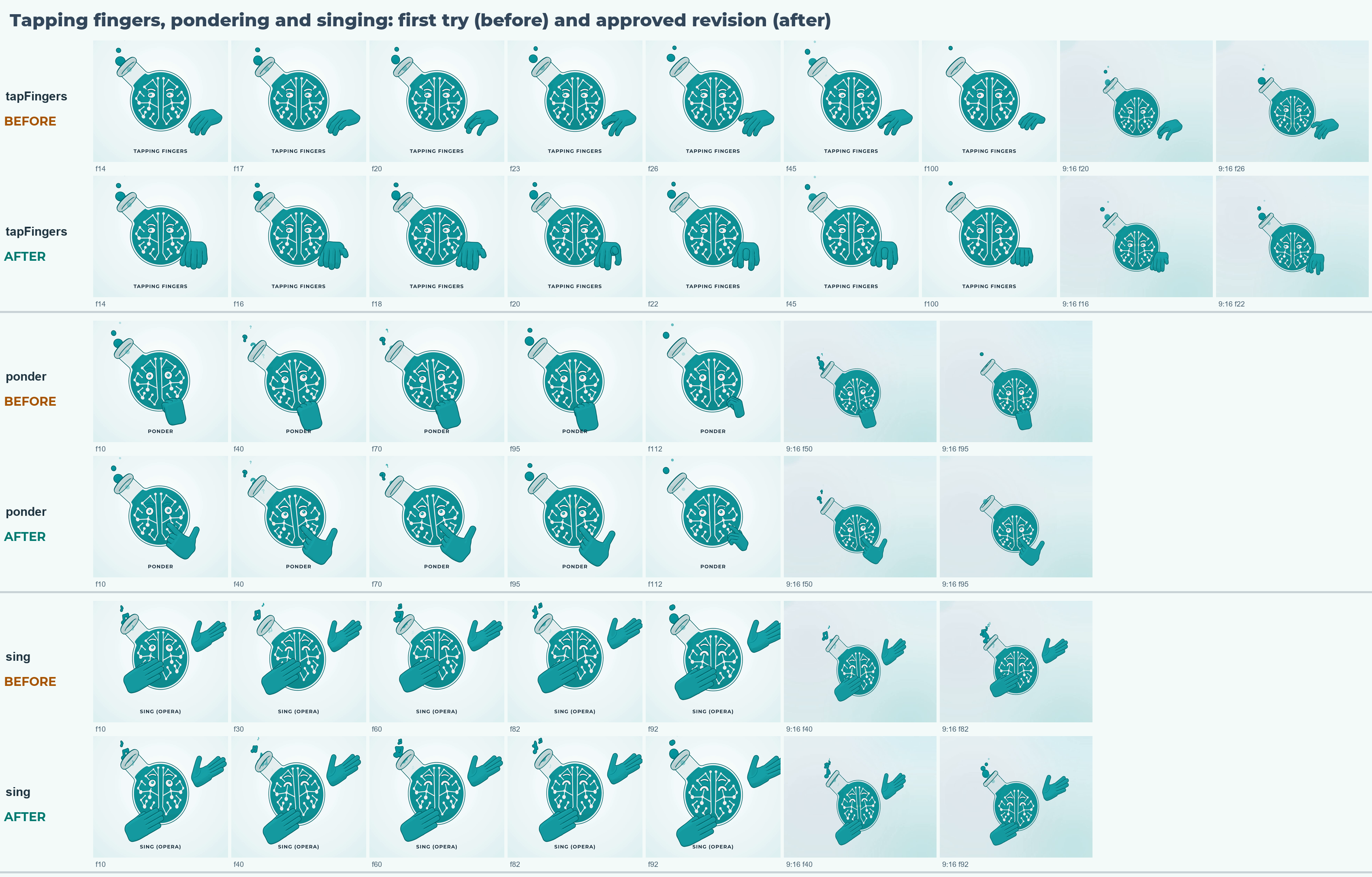
Finger tapping: from a hand hanging off the flask to impatience
The brief was impatient drumming on a table, with a bored face. The first version drummed beside his base, side-on, with the fingers pointing in toward him. Joseph's note: it read as a hand hanging off the flask.
The fix turned the hand to face the camera and pulled it in tight against the lower right of his bulb, knuckles and fingertips toward us. That created a new problem worth knowing about. With the fingers aimed at the camera, lifting a finger moved its tip toward the lens, so from the front the tapping disappeared. The approved version raises each finger past straight, one after another, so each one pops up out of the row of knuckles where you can see it.
Pondering: from a fist to thumb and forefinger
The first ponder put a fist under his chin. Joseph wanted thumb and forefinger holding the chin instead. That needed a new hand shape: thumb out wide, index finger nearly straight, the other three curled, with the back of the hand to the camera so the lower bulb sits in the V between thumb and finger.
It also had to stay distinct from his "think" move, a single raised index finger. A hand on the chin has to show two fingers, or it reads as "think".
Singing: from a hand over the face to a hand at the base
Opera is a combination move: a hand on the heart, the other arm flung up and out, chest out, eyes shut on the long note, a little vibrato and music-note bubbles. The first version put the heart hand across the middle of his bulb. Joseph reads the lower middle of the bulb as the Professor's mouth, so that hand was covering his face.
The fix lowered it to the very bottom of the bulb, fingers across the bottom edge. It had to stay clear through the whole move, not only the big moment, because the bow at the end swings the lower bulb toward the hand.
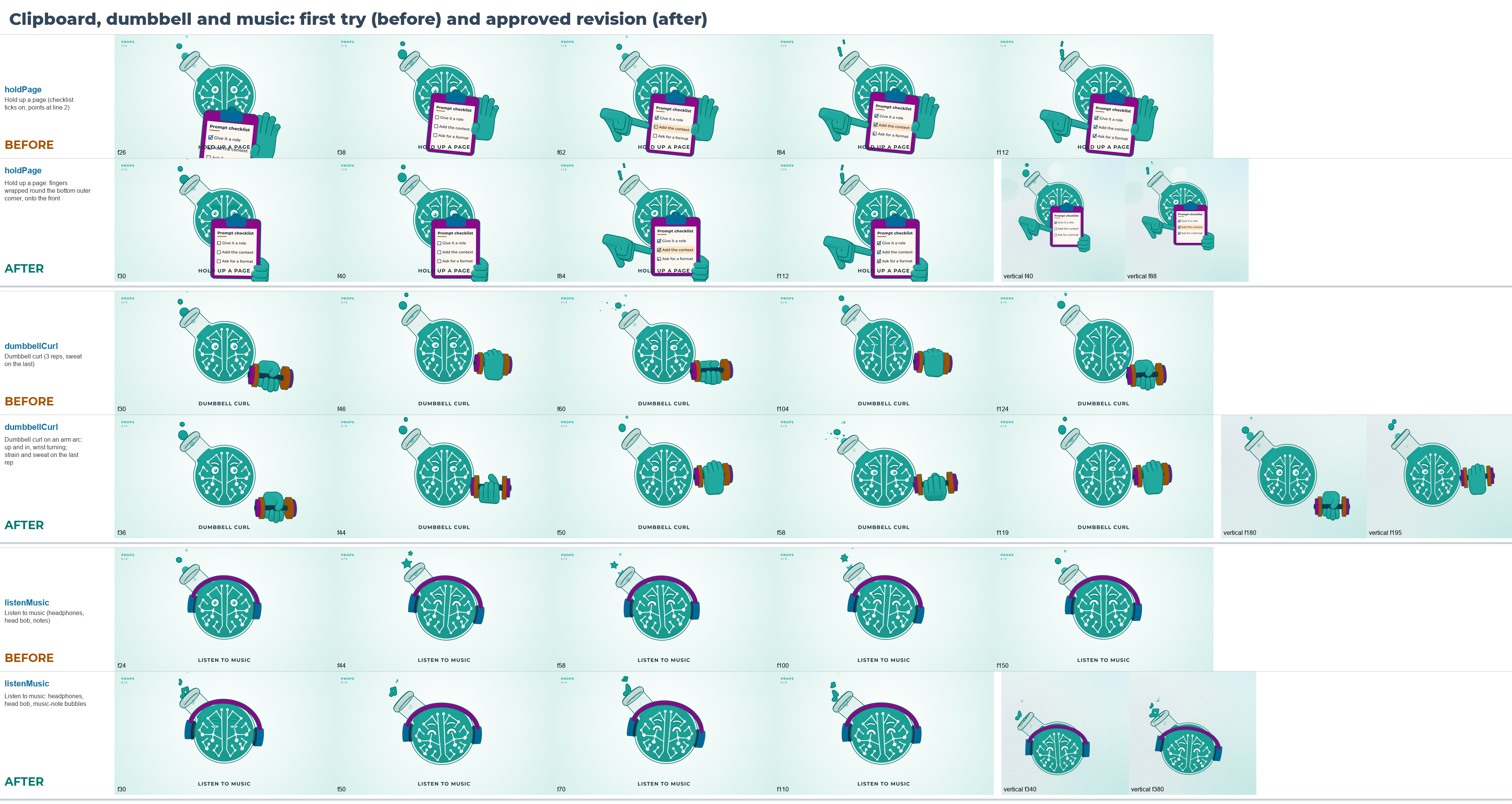
The clipboard: from an open hand to fingers wrapped round the edge
The clipboard is one of his most useful props, because its page shows whatever text a video needs. In the first version an open hand sat beside the board with the fingers along its back. Technically he was holding it. Joseph's note: it doesn't read as holding it.
The revision gave him a new grip. His fingers now reach past the bottom outer corner and hook onto the front of the board, with the palm and thumb behind, the way you would hold a real clipboard. The corner sits at his little finger, so his fingers cover only the margin and the text stays clear.
The same round fixed a glitch nobody had flagged: for one frame as the page appeared, the checklist's ticks flashed on and vanished.
The dumbbell: from a wrist turn to a lift
The first curl moved the fist between three positions close together. The big dumbbell kept getting nudged back out of his glass, so in practice only the wrist turned. Joseph's note was five words: "imagine an arm is attached."
That note became the fix. The fist is now the end of an imagined forearm that swings around an imagined elbow beside his lower bulb. It rises about a hand's height and draws in toward him, turning as it travels, the way a real curl does. The squint, the breath at the top of each rep, and the tremble and sweat drop on the last one all stayed as they were.
Music: from stars to musical notes
Listening to music puts headphones on him and sends little shapes floating up. In the first version those shapes were stars. Joseph's note: stars where music belongs.
This was the easiest fix. Another agent was building music-note bubbles for singing and dancing at the same time, so once the two pieces of work were combined, swapping stars for notes took one line.
Five 3D animation principles we now build by
The six notes add up to five rules, now written into the guide the agents read before building any new move.
1. Grips must wrap. A hand beside an object isn't holding it, even if the geometry says it is. People read a grip when they can see fingers curled over the thing.
2. Motion needs an arc. A hand that only turns at the wrist looks like a trick. Real limbs swing from a joint, so the hand travels on a curve. This is the classic principle of arcs, rediscovered with a dumbbell.
3. Keep the face clear. The face is where viewers look first, so nothing crosses it, in any frame of the move. For the Professor that includes the lower middle of the bulb, which reads as his mouth. Animators call the wider idea staging: arrange everything so the one thing that matters is easy to see.
4. One flash, never a strobe. When the lightning bolt hits him, the whole frame flashes once, for about a quarter of a second, and fades. The bolt is drawn once and never flickers into new shapes. Repeated bright flashes are hard to watch and can be a real risk for people with photosensitive epilepsy, which is why web accessibility guidelines limit them.
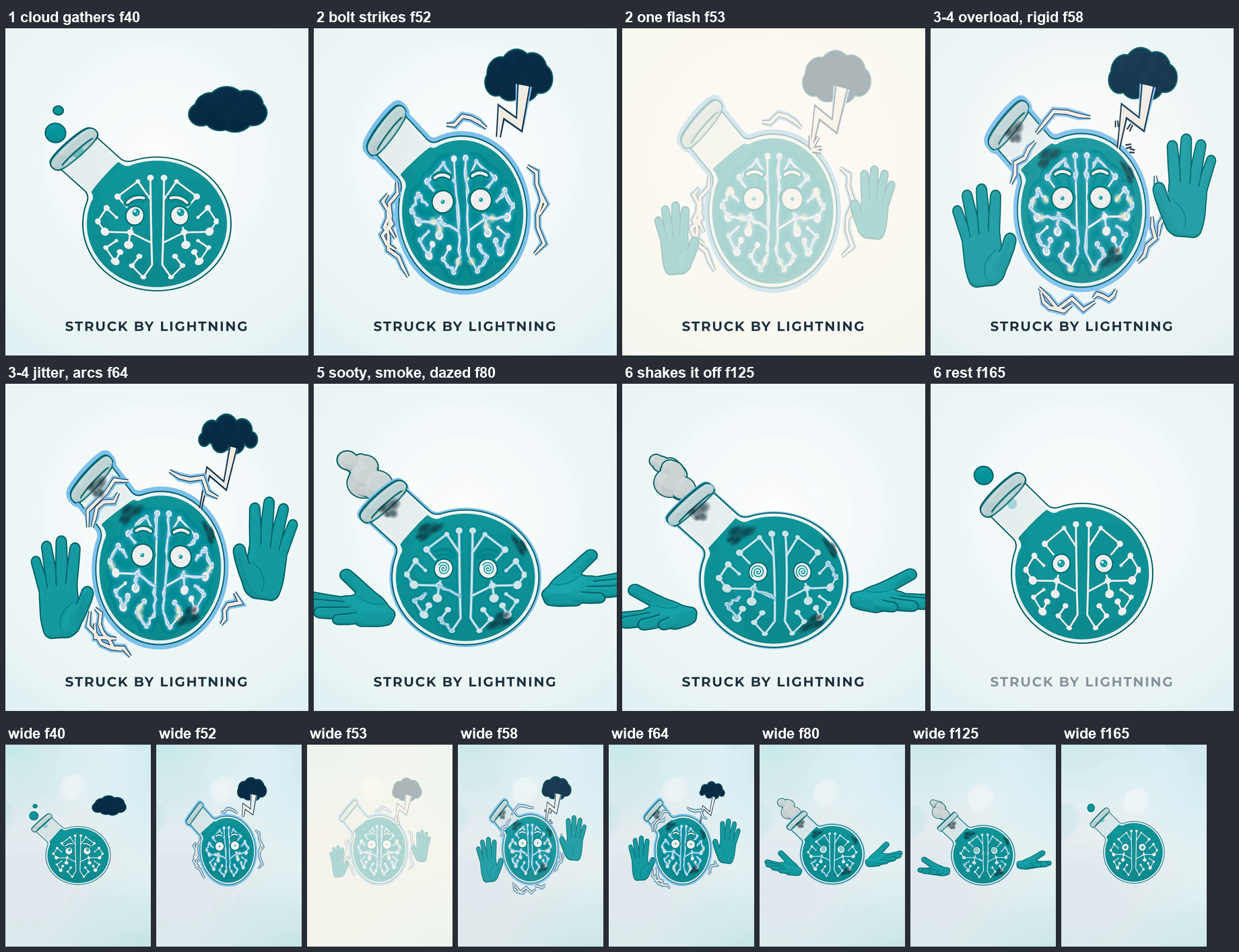
5. Readable from across a room. Every move has to work small and at a distance: on a phone screen, or glimpsed from across a room. If the silhouette doesn't come across at that size, the move isn't done.
Under the hood: the one-flash rule is enforced by an automated test that counts how many times the flash brightens during the move. The answer must be exactly one. The lightning strike's other problems were caught before Joseph saw it: the bright bolt vanished against the light background until it got a dark edge, and a bolt with rounded joints looked like a bent pipe until it got sharp corners.
How to review an animation when you're not an animator
Joseph isn't an animator, and he didn't review these moves against a spec sheet. He looked at the renders and said what he saw. That turned out to be exactly what the work needed.
Here's why "looks right to me" beats a spec sheet. A spec describes what the builder intended: the hand at this position, the fingers at this angle. The first clipboard and the first curl both did what they were built to do, and both still failed. The question that matters is whether a viewer gets it, and only a person looking at the result can answer that.
If you review creative work, animated or otherwise, a few habits from this round travel well.
- Ask for the result in the format your audience will see. Small, and vertical if it's going on a phone. A big monitor flatters everything.
- Say what you see, not how to fix it. "It reads as a hand hanging off the flask" gave the builder a clear target and left the how to them. "Imagine an arm is attached" did the same in five words.
- Approve what works, and freeze it. The six moves that passed round 1 weren't touched in round 2.
- Keep rounds small and close together. The second round of fixes was committed the same morning as the first versions, while each note was still fresh.
- Write the lessons down. Each note became a rule in the guide, so the next batch starts from what this one learned.
The honest trade-offs
Review takes time, and it's the one step you can't hand off. Half of this batch needed a second round. That's normal for new creative work, so plan a revision round into the schedule instead of hoping for none.
Reviews also depend on the reviewer. Joseph knows the Professor well enough to see that a hand over the lower bulb covers his mouth. A newcomer may need a short note on what matters: here is the face, here is what must always show. Writing that down is part of owning a brand character.
Try it on your next review
Pick one piece of visual work your team is reviewing this week. Look at it at the size your audience will, for about a second, and write down what you think it says. If that isn't what it was meant to say, you have your review note.
Next in the series: how the work got done, with AI agents working in parallel like a small animation studio, and where people stay in charge.
Want a character like the Professor for your organization, or animated explainers built this way? Let's talk. Book an AI Opportunities Discussion.
Frequently Asked Questions
What are the principles of animation?
The principles of animation are guidelines animators use to make motion clear and believable, such as squash and stretch, anticipation, staging, arcs, timing and appeal. The best-known set is the twelve described by Disney animators Ollie Johnston and Frank Thomas in 1981.
What are the 12 principles of animation?
The classic twelve are squash and stretch, anticipation, staging, straight ahead action and pose to pose, follow through and overlapping action, slow in and slow out, arcs, secondary action, timing, exaggeration, solid drawing, and appeal. They come from the 1981 book The Illusion of Life, and teams often add their own working rules on top.
What is one of the 12 principles of animation?
Arcs is one: living things move along curved paths, because limbs swing from joints. Our dumbbell curl only read as a curl once the fist travelled on an arc from an imagined elbow.
What does it mean for an animation to "read"?
An animation reads when a viewer understands the action or feeling in one glance, without explanation. We test it with small still frames at phone size: if the main shape isn't clear there, the move needs more work.
How do you give feedback on an animation if you're not an animator?
View it at the size your audience will, then describe what you see in plain words, such as "the hand looks like it's hanging off him." Leave the how to the builder and approve what already works.
How many review rounds does a new animation need?
Plan for at least two. In our batch of twelve moves, six were approved on the first review and six needed one more round, and all twelve were approved and merged after the second.