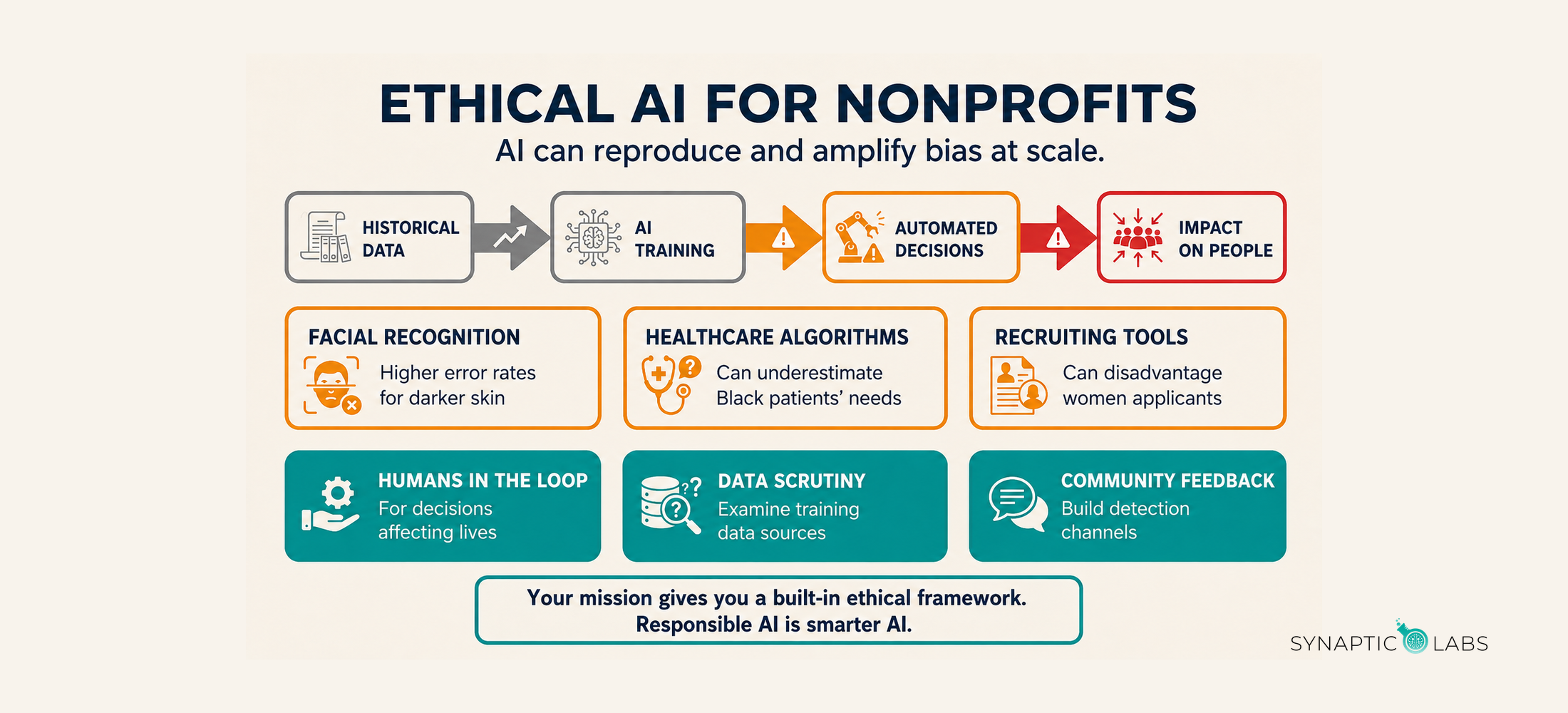
Organizations dedicated to equity can still reproduce inequity through poorly chosen or poorly governed AI.
The risk is not theoretical. NIST testing has documented demographic differences in face-recognition error rates, including higher false-positive rates for some demographic groups in many—but not all—algorithms. A widely cited study published in Science found that a health-management algorithm underestimated the needs of Black patients because it used healthcare spending as a proxy for health need.
These findings do not mean every AI system is biased in the same way. They show why context, data, testing, and human accountability matter—especially when technology affects vulnerable communities.
Where AI Risk Comes From
Bias can enter at many points: the problem an organization chooses to solve, the data used, the proxy selected for an outcome, the way a model is tested, and the way people interpret its output.
The NIST AI Risk Management Framework describes trustworthy AI in terms that include validity, safety, accountability, transparency, privacy, and fairness with harmful bias managed. It also emphasizes that risk management is continuous across the AI lifecycle.
For nonprofits, that means an ethics review cannot be a one-time checkbox at procurement. AI governance for nonprofits has to be a standing practice, with a written AI policy that people can actually follow.
Three Practices for Responsible Nonprofit AI
1. Define Human Responsibility
For high-stakes uses, decide who reviews the output, who can override it, who explains the decision, and who is accountable when something goes wrong.
Low-risk assistance—such as outlining a public report—may need a standard editorial review. A tool involved in eligibility, hiring, funding, health, safety, or service allocation requires much stronger oversight and may not be appropriate at all.
“Human in the loop” only works when the human has enough time, authority, information, and training to challenge the system.
2. Scrutinize Data and Outputs
Treat every purchase as an AI vendor risk assessment for nonprofits, and ask practical questions:
- What data does the system collect and retain?
- Is customer data used for model training?
- What groups were represented in evaluation data?
- Are performance results available across relevant populations?
- Can your organization audit outputs and report problems?
- What happens when the system is uncertain?
Then test the tool in your own context. Track errors and outcomes across the populations you serve. A vendor’s general accuracy claim does not replace local evaluation.
3. Include Affected Communities
People affected by an AI-assisted process should have a way to understand it, provide feedback, and challenge harmful outcomes.
Invite community representatives into design and review before deployment. Pilot in a low-risk setting. Explain what the tool does in plain language. Create a visible path for reporting problems. Stop or redesign the use when evidence of harm appears.
Community participation is not a public-relations step. It is a source of knowledge the technical team may not have.
A Four-Week Sprint to an AI Policy for Nonprofits
Week 1: Inventory. List every AI tool staff currently use, including informal use. Identify the data involved and the decisions influenced.
Week 2: Classify risk. Separate low-risk drafting and organization from higher-risk uses affecting people, money, employment, services, or rights.
Week 3: Write controls. Define approved tools, prohibited data, review requirements, accountability, incident reporting, and retention expectations.
Week 4: Train and test. Give staff realistic scenarios. Practice checking facts, detecting bias, protecting data, documenting AI assistance, and escalating concerns.
By the end of week three you have the core of an AI policy template for nonprofit organizations: approved tools, prohibited data, review requirements, accountability, incident reporting, and retention. Treat the policy as a living document. Tools, laws, risks, and community expectations change.
The Leadership Opportunity
Nonprofits are not automatically better at AI because they have values. They are better positioned when they turn those values into governance, testing, transparency, and accountability.
Responsible AI is not slower by definition. Preventing harm, rework, reputational damage, and loss of trust is part of good implementation.
AI can support a mission only when the organization remains responsible for how the technology is selected, used, and challenged.
Frequently Asked Questions
How do you implement ethical AI in a nonprofit?
Inventory current use, classify each use by risk, write controls for the high-risk ones, and train staff on realistic scenarios. Keep a named human accountable for any decision that affects people, and give affected communities a way to question outcomes. The four-week sprint above is a workable first pass.
What should an AI policy for nonprofits include?
At minimum: which tools are approved, which data may never be entered, what level of human review each use requires, who is accountable, how staff report problems, and how long data is retained. Add a disclosure rule for when AI assistance matters to the reader, and a review date.
Is an AI policy necessary for a small nonprofit?
Yes, and it can fit on one page. Small teams are more likely to have informal AI use with no shared rules, which is where data and accuracy problems start. A short written policy turns scattered use into a governed practice without slowing anyone down.
Want a practical starting point for responsible workflows? Use code FREEFLOW for free access to our Nonprofit Flow Course.
Massachusetts nonprofits: You may be eligible for AI training and implementation support through our CommCorp grant program.
Need help developing an AI governance framework? Contact the Synaptic Labs team.