Is AI worth investing in for small nonprofits? The honest answer is yes, but not the way vendors mean it. There are two bad AI strategies: adopting tools carelessly and refusing to learn anything until every uncertainty disappears.
The safer path sits between them. A nonprofit can explore small, low-risk uses, measure the full workflow, protect sensitive data, and build governance before scaling.
Waiting has a cost—not because every peer organization will suddenly become an unbeatable “AI competitor,” but because learning is cumulative. Teams that run thoughtful pilots develop shared language, realistic expectations, internal skills, and better policies. Organizations that never experiment do not get that learning for free later.
What Actually Compounds
Workflow Knowledge
A two-week pilot reveals where instructions are unclear, which source material is missing, where quality breaks down, and how much review is required. Even a failed pilot can be useful if the organization documents what happened.
Staff Judgment
People improve at deciding when AI is useful, when it is unreliable, and how to verify the output. That judgment is more valuable than familiarity with any single product.
Governance
Real use cases make policy concrete. Instead of debating AI in the abstract, leaders can define approved tools, prohibited data, review requirements, retention rules, and accountability around a workflow they understand.
Integration
A successful pilot can become a documented process, then a reusable template, then part of a larger system. Each step depends on evidence from the step before it.
The Risk of Moving Too Fast
The cost of standing still should not become an excuse for reckless adoption.
Unapproved tools can expose sensitive data. Unchecked drafts can publish false claims. Automation can conceal bias or shift responsibility away from people. A poorly selected tool may create more work than it saves.
That is why the goal is not “AI everywhere.” It is organizational learning with boundaries.
The 2025 State of AI in Nonprofits report, based on responses from more than 1,300 nonprofit professionals, found that 76% of respondents said their organizations did not have an AI strategy. The gap is not simply access to tools. It is the ability to turn scattered use into a shared, governed approach.
Run a Reversible AI Pilot Program
Choose one task that is:
- low in consequence;
- frequent enough to measure;
- based on information you are allowed to use;
- easy for a person to review; and
- simple to stop without disrupting service.
Examples include a draft agenda from approved notes, a summary of a public document, a first-pass outline, or reformatting content into a standard template.
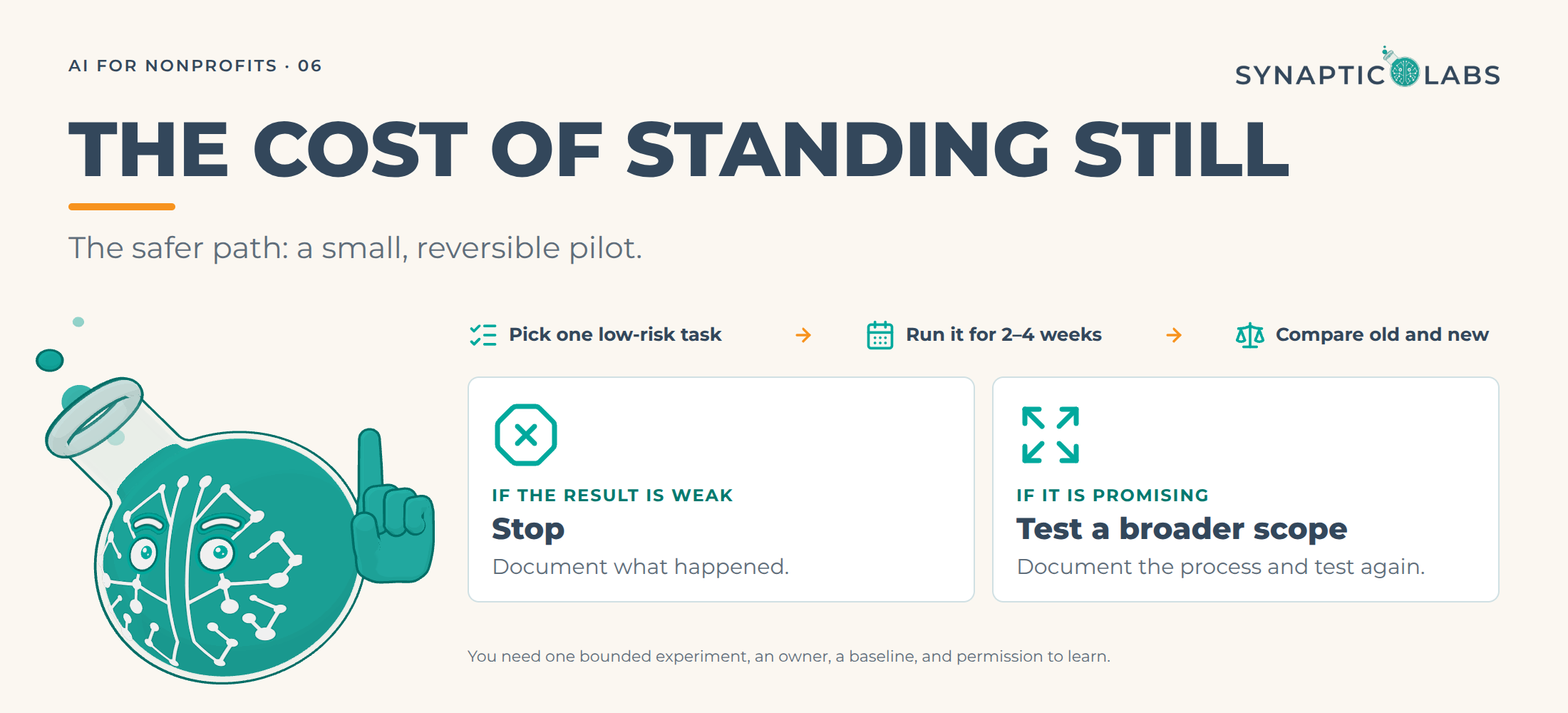
Set a two- to four-week window. Compare the old and new processes on:
- total staff time, including review and corrections;
- factual and stylistic quality;
- data and privacy risk;
- staff confidence and frustration; and
- whether any saved capacity reached mission work.
If the result is weak, stop. If it is promising, document the process and test again with a slightly broader scope. That is how to implement AI at a nonprofit without betting the organization on it, and it is what nonprofit AI adoption should look like at every size.
The Best Time to Build Judgment
AI products will keep changing. That makes durable capabilities more important: problem selection, data stewardship, verification, risk classification, and change management.
You do not need a transformation program to start building those capabilities. You need one bounded experiment, an owner, a baseline, and permission to learn.
The real cost of standing still is not missing a fashionable tool. It is postponing the organizational learning required to use any future tool responsibly.
Frequently Asked Questions
How can nonprofits manage AI-driven change?
Keep it bounded and reversible. One workflow, one owner, a baseline, a review step, and a stop condition let a team learn without committing the whole organization. Share results, including failures, so the next pilot starts from evidence rather than opinion.
What happens if a nonprofit waits on AI?
Nothing dramatic on day one, which is why waiting feels safe. What is lost is cumulative learning: workflow knowledge, staff judgment, concrete governance, and the ability to evaluate future tools. Those capabilities take months to build and cannot be bought later.
How much should a small nonprofit spend on a first AI pilot?
Usually very little. Most first pilots run on free or existing tools and cost staff time rather than money. The real investment is two to four weeks of attention from an owner who measures the complete workflow, including review and corrections.
Ready to run a small, governed pilot? Use code FREEFLOW for free access to our Nonprofit Flow Course.
Massachusetts nonprofits: You may be eligible for AI training and implementation support through our CommCorp grant program.
Need help designing a reversible first experiment? Contact the Synaptic Labs team.